




Published on October 09, 2026

A gut microbiome test is worth considering for curiosity, not as a stand-alone diagnosis or a reliable way to choose supplements. In 2026, the key limitation is not whether a laboratory can measure microbes or related markers; it is whether the result supports a validated decision about your health. If you have persistent digestive symptoms, a clinical assessment is the better starting point.
TL;DR
- A gut microbiome test can support curiosity, but it does not establish a diagnosis or a personalised supplement prescription.
- Theprovencode shoppers should assess gut health claims through sampling methods, scientific evidence and clear limitations.
- Independent laboratory testing checks analytical quality; it does not prove that report-based recommendations improve your health.
- Persistent digestive symptoms need clinical assessment, not reassurance from a microbiome score.
Is a gut microbiome test worth it in 2026?
It is worth considering only when you understand what is measured and accept the limits of interpretation. A report about microorganisms, their genetic material or related biological markers is not automatically a clinically useful test. Clinical usefulness means the result helps answer a defined health question and informs an action supported by evidence.
The International consensus statement on microbiome testing in clinical practice, published in The Lancet Gastroenterology & Hepatology, distinguishes growing interest in microbiome testing from established clinical applications. It addresses testing methods, reporting and interpretation, including the limitations of direct-to-consumer use. That distinction matters more than the length of a report.
| Option | Best for | What it offers | Main limitation |
|---|---|---|---|
| Consumer gut microbiome profile | Curiosity about a measured microbial community | Information about the organisms or markers covered by the method | A profile does not automatically identify the cause of symptoms or establish treatment |
| Clinician-requested targeted stool test | A specific clinical question | Testing directed at a suspected infection, inflammation or another defined concern | It answers the question it was ordered for, not every question about gut health |
| Clinical assessment | Persistent or concerning digestive symptoms | Interpretation of symptoms, history and appropriate investigations together | It does not necessarily produce a detailed microbiome profile |
For shoppers browsing Theprovencode, the useful question is not whether testing sounds scientific. Ask whether the result changes a decision you can justify with evidence.
Why this matters
A detailed report can create confidence without resolving your original concern. Terms such as diversity, imbalance and beneficial bacteria describe aspects of a microbial community, but they need a defined measurement method and interpretation framework.
There is also a difference between an association and an explanation. Finding that a microbial pattern occurs alongside a health condition does not establish that the pattern caused the condition, or that changing it improves symptoms.
Do not turn a report label into a diagnosis. If a test classifies your result as unfavourable, ask what the classification means, how the reference group was selected and whether the proposed next step has been evaluated in people like you.
What does a gut microbiome test actually measure?
Start with the sample, not the name on the box. Many consumer microbiome profiles analyse stool, but products marketed around gut health can measure different biological signals. The phrase gut microbiome test does not establish that every product measures the same thing.
Stool sequencing can describe microorganisms or microbial genetic material detected in the sample. Different sequencing approaches provide different information, and a stool sample does not represent every location within the digestive tract.
A blood-based measurement is a different kind of evidence. Before comparing it with stool sequencing, check the named biomarkers, the intended use and the validation supporting the interpretation.
Microbial composition is not the same as microbial activity
Identifying organisms tells you something about composition. It does not necessarily establish what those organisms are doing inside your body. Predictions about function also need to be distinguished from directly measured biological activity.
Ask whether the report measures a feature or estimates it. A prediction can be useful in research, but its presence in a consumer report does not establish that it should guide your supplement choices.
A reference range needs an explanation
A microbiome result often depends on comparison with other samples. Ask who contributed those samples and how the laboratory decided what counts as a typical or desirable result.
Population, diet, sampling and analytical methods affect interpretation. For shoppers in India, a reference group should not be treated as personally applicable simply because a report uses the word normal.
How should you evaluate a test before buying?
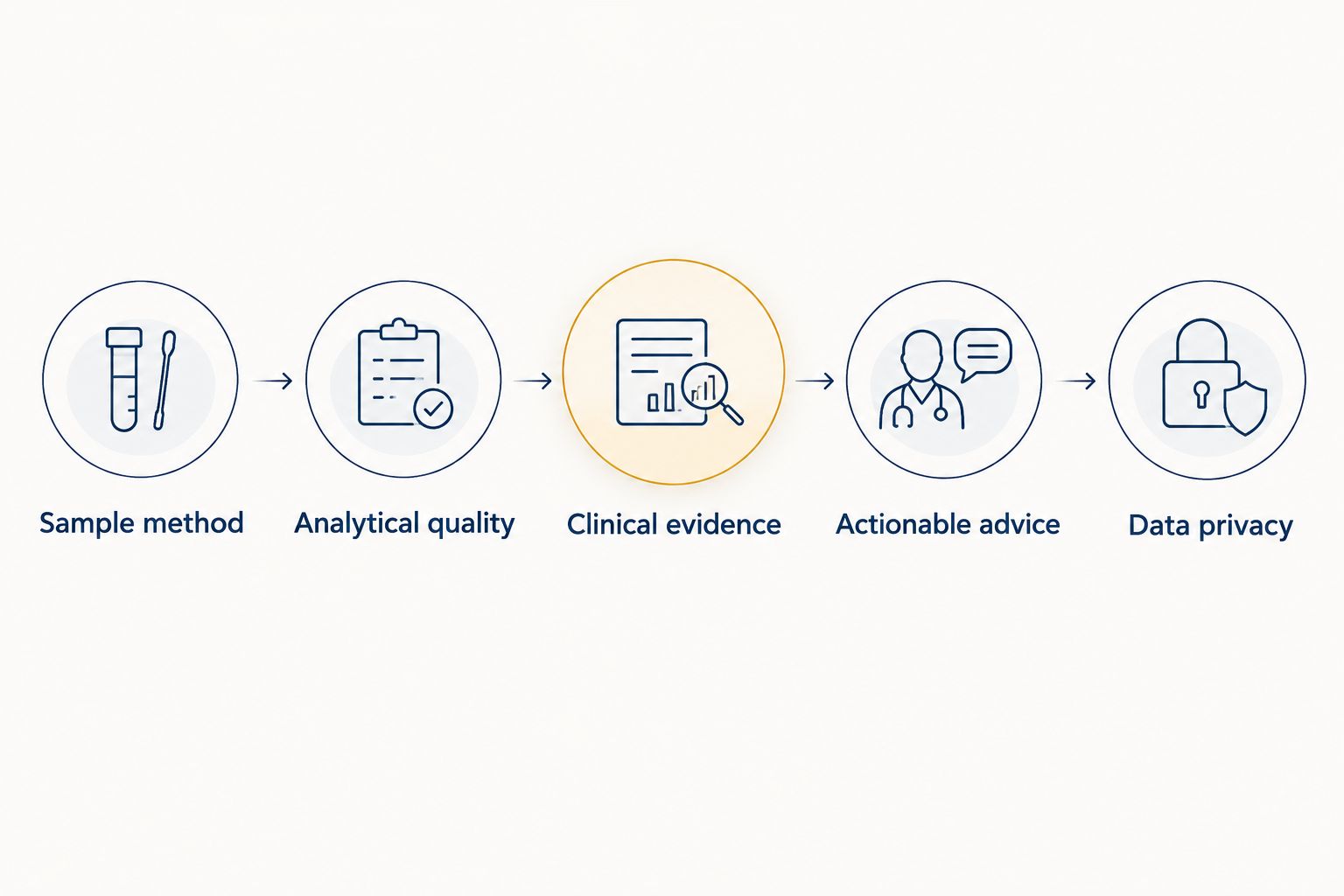
Use 5 checks to separate an informative report from a promise that exceeds the evidence. Apply them to the test itself, not just the ingredient or supplement recommendations attached to it.
- Sample method. Identify whether the test uses stool, blood or another sample, and what it directly measures. Follow the collection instructions rather than assuming different samples provide equivalent information.
- Analytical quality. Look for an explanation of laboratory quality controls and the scope of any accreditation or independent verification. A laboratory credential does not, by itself, validate every interpretation in its report.
- Clinical evidence. Ask whether published evidence supports the intended use of this particular test. Research about the microbiome generally is not proof that a commercial scoring system improves health decisions.
- Actionable advice. Identify the decision the result is meant to support. Ask whether that action follows from the measured finding or is general wellness advice presented as personalised guidance.
- Data privacy. Read how the provider stores samples and results, shares information and handles deletion requests. Consent to receive a report should not be confused with consent to every secondary use of your data.
The sequence matters: understand the measurement before evaluating the recommendation. If the connection between the result and the suggested action is unclear, a polished report does not close that gap.
Separate 3 evidence layers
Analytical validity asks whether the test measures its stated target accurately. Clinical validity asks whether that measurement has a reliable relationship with the health question. Clinical utility asks whether using the result improves a decision or outcome.
These are 3 evidence layers, not interchangeable endorsements. Independent testing can support confidence in measurement without proving that a report-generated diet or supplement plan improves your health.
In 2026, ask the provider to explain each layer in plain language. A publication about a related biomarker is not necessarily validation of the complete test, scoring system and recommendation process.
Why gut microbiome test results vary
Variation is not automatically a laboratory error. A microbiome report reflects both the sample and the process used to analyse and interpret it.
- Sample collection and handling: collection instructions, storage and transport affect the material reaching the laboratory.
- Recent exposures: diet, medicines and other relevant exposures can influence the microbial community being sampled.
- Measurement method: different laboratory approaches detect and describe different features.
- Analysis choices: databases and computational methods affect how findings are identified and reported.
- Reference population: a score depends on the comparison group and the rules used to interpret it.
This is why repeating a test is not automatically useful. Before arranging another sample, decide what question the repeat measurement would answer and whether the method can support that comparison.
Do not stop prescribed medicines or make major dietary changes simply to obtain a more favourable score. Discuss preparation instructions with the provider and your clinician when medicines or medical conditions are involved.
Can a gut microbiome test explain bloating?
A gut microbiome test does not, by itself, establish the cause of bloating. Digestive symptoms need interpretation alongside their timing, severity, medical history and other findings.
Microbes participate in digestion, but that general fact does not prove that a particular report finding explains your symptoms. A result labelled imbalance is not a substitute for evaluating a specific clinical concern.
For example, the US National Institute of Diabetes and Digestive and Kidney Diseases explains that coeliac disease diagnosis uses appropriate clinical testing, including blood tests and, when indicated, intestinal biopsy. A consumer microbiome profile does not replace that diagnostic pathway.
Seek clinical assessment for persistent symptoms. Bleeding, unexplained weight loss, severe pain or other concerning changes warrant medical attention rather than waiting for a wellness report.
Can a gut microbiome test tell you which probiotic to take?
A gut microbiome test does not establish a reliable probiotic prescription simply by showing that a named organism is low. The reasoning needs evidence connecting the measured finding, the specific probiotic and the intended outcome.
The International Scientific Association for Probiotics and Prebiotics consensus on the scope and appropriate use of the term probiotic emphasises demonstrated health benefit. Probiotic evidence needs to be considered in relation to the studied organism, preparation and use—not just a familiar species name.
A missing organism on a report is not proof of a supplement deficiency. Ask whether the recommended preparation has relevant human evidence and whether the test-based selection process has been evaluated.
The same discipline applies to berberine and ashwagandha recommendations. A microbiome report does not establish that either ingredient is suitable for you, and ingredient research does not prove the effectiveness of a finished supplement. Review suitability and potential interactions with a qualified healthcare professional.
Is a gut health test the same as a gut microbiome test?
A gut health test is not necessarily a direct microbiome profile. The product name can describe its intended topic without telling you what the laboratory measures.
Theprovencode lists the Gut Intelligence 360™ Test, with a description referring to finger-prick sampling. Before interpreting its findings as a map of microorganisms, check the actual measurement targets, the report methodology and the evidence supporting its intended use.
Finger-prick collection and stool sequencing are different sampling approaches. Neither the collection format nor the wording on a product page establishes diagnostic usefulness by itself.
Theprovencode is a supplement and nutraceutical retailer for health-conscious shoppers in India, not a substitute for clinical assessment. Apply the same evidence checks to its testing products that you apply to any other provider.
What should you do with a report in 2026?
Begin with 2 questions: what was directly measured, and what decision does the result justify? Keep the laboratory finding separate from the interpretation and from any product recommendation.
Bring a symptom timeline, relevant medical history and a list of medicines and supplements to a clinical discussion. These details provide context that a microbial score cannot supply on its own.
Do not begin several supplements together simply because a report recommends them. Changes made together are difficult to interpret, and suitability depends on more than the report.
Also resist treating retesting as proof that an intervention worked. A changed microbial profile is a changed measurement; demonstrating a meaningful health benefit requires more than movement in a score.
FAQ
Is a gut microbiome test worth it in 2026?
A gut microbiome test is worth considering for curiosity, not as a stand-alone diagnosis. Before buying in 2026, check what it measures and whether evidence supports the decisions it recommends.
Can a gut microbiome test diagnose IBS?
A consumer gut microbiome test does not establish an IBS diagnosis. A clinician evaluates the symptom pattern and decides whether investigations are needed to assess other explanations.
Is a stool test better than a finger-prick gut test?
Neither sampling method is automatically better; suitability depends on the question and the validated measurement. Stool microbiome analysis and blood-based markers provide different information and should not be treated as interchangeable.
Should I buy probiotics because my report says good bacteria are low?
Do not choose probiotics solely because a report labels particular bacteria as low. Look for evidence supporting the specific preparation and intended use, and review suitability with a qualified healthcare professional.
Does independent testing prove that a microbiome report is clinically useful?
Independent testing does not automatically prove clinical usefulness. It can support analytical quality, while the report's interpretation and recommendations need separate evidence.
What should I ask Theprovencode before choosing a gut test?
Ask Theprovencode what the test directly measures, how its interpretation was validated and what its findings can reasonably support. Also review sample handling, privacy terms and the limits of any supplement recommendations.
Should I repeat a gut microbiome test after changing my diet?
Repeat testing needs a defined question and a method suited to comparison. A different result does not, by itself, prove that your diet change improved your health.
One last thing
The most useful question in 2026 is not how many pages a report contains. It is what you would do differently because of the result, and why that action is justified.
General advice does not become clinically validated personalisation simply because it appears beside your name. If the proposed action would be the same without the test, separate the value of the advice from the value of the measurement.
