




Published on October 09, 2026

Best named supplement to assess: Daily Probiotics 360. Best for a specific health question: a strain-matched probiotic discussed with your clinician. Best food-first option: plain yoghurt with live cultures. This 2026 guide to the best probiotics in India explains how to compare those choices, including the label details available for The Proven Code.
TL;DR
- Best probiotics in India: compare strain identity, relevant evidence and viable counts, not the largest CFU number.
- The Proven Code's Daily Probiotics 360 names LactoSpore MTCC 5856; verify evidence and batch testing before choosing.
- Choose a clinician-reviewed, strain-matched probiotic when your question concerns a specific health problem.
- Plain yoghurt with live cultures is a food-first option, not an equivalent to a studied probiotic supplement.
Why this matters
A probiotic label tells you what a manufacturer intends to supply. It does not, by itself, establish what that product will do for you. A recognised ingredient, a large bacterial count and a reassuring claim answer different questions.
The World Gastroenterology Organisation's Global Guidelines: Probiotics and Prebiotics explains why probiotic evidence must be connected to particular strains and uses. The NIH Office of Dietary Supplements' Probiotics Fact Sheet for Health Professionals also distinguishes organisms, viable counts and the evidence for different applications.
For your 2026 shortlist, ask whether the evidence matches the organism, formulation and reason you are considering it. The Proven Code's Daily Probiotics 360 is best for shoppers who want to start their probiotic comparison with a named strain and declared quantities. That is a label-based verdict, not a finding that the finished product outperforms alternatives.
What makes the best probiotics in India in 2026?
Use these criteria before comparing packaging or testimonials:
- Strain identity: Look for the organism's full identification, including its strain designation. A species name alone does not identify the exact organism studied.
- Relevant evidence: Ask what outcome was measured, in whom, and with which formulation. General gut-health language is not a study endpoint.
- Viable count: Check the colony-forming units, or CFU, and whether the stated count applies through expiry under the specified storage conditions.
- Formulation clarity: Separate the probiotic from added fibres and other ingredients. Evidence for one component does not establish the effectiveness of the combination.
- Independent verification: Ask what testing covers, which laboratory performed it, and whether the report relates to the batch you are considering.
- Practical suitability: Review storage instructions, allergens, preparation and safety considerations before choosing a format you can use consistently.
These checks keep identity, quality and effectiveness separate. A product can describe its ingredients clearly without proving a particular health benefit; a study can support a strain without verifying the contents of an individual sachet.
Probiotic options at a glance
This shortlist ranks different buying routes, not interchangeable treatments. The first is a named supplement; the others help you decide whether a targeted supplement or an ordinary food better fits your question.
| Rank and option | Best for | Standout detail | Key limitation |
|---|---|---|---|
| 1. Daily Probiotics 360 | Comparing a named-strain supplement with added fibre | LactoSpore MTCC 5856 at 6 billion CFU, plus 750 mg PHGG in a 5 g sachet | Ingredient details alone do not prove finished-product effectiveness |
| 2. Clinician-reviewed, strain-matched probiotic | Evaluating a specific health question | Selection starts with the relevant study and strain | A suitable choice requires a defined purpose and safety review |
| 3. Plain yoghurt with live cultures | A food-first approach | Fits into an ordinary meal rather than a supplement routine | Live cultures do not automatically make it equivalent to a studied probiotic |
Read the table as a decision tree. If you want a supplement, examine its strain and documentation. If you have a health problem, define that problem before choosing an organism. If you want a food, judge it as a food rather than assigning it supplement claims.
1. Daily Probiotics 360: best for label-led supplement comparison
Daily Probiotics 360 from The Proven Code is described as a once-daily 5 g sachet containing LactoSpore® MTCC 5856 at 6 billion CFU, alongside 750 mg partially hydrolysed guar gum, or PHGG. Those details give you concrete information to investigate rather than relying only on a general probiotic claim.
The strain designation matters because it helps connect the ingredient to research about that exact organism. PHGG is a separate formulation component. Its presence should prompt a separate question about its purpose and supporting evidence, not an assumption that the whole sachet has been clinically demonstrated to work.
Daily Probiotics 360 pros
- The ingredient description includes MTCC 5856, a strain designation you can use when checking research.
- The declared 6 billion CFU gives you a bacterial-count claim to examine.
- The 750 mg PHGG amount distinguishes the added fibre from the probiotic component.
- The 5 g sachet format makes the stated serving quantity explicit.
Daily Probiotics 360 cons
- A named strain does not establish effectiveness for every digestive complaint.
- Added fibre makes this a combination formula rather than a probiotic-only option.
- A CFU declaration still needs context about expiry, storage and verification.
Best for: Shoppers who want to compare a named probiotic strain and declared formulation quantities.
Before choosing Daily Probiotics 360, ask for the research supporting the intended use and the documentation supporting the product's quality claims. Check whether any cited trial tested the finished formula or only an ingredient. These are different levels of evidence.
A useful response identifies the study population, measured outcome and tested formulation. A useful testing report identifies the sample and scope of testing. Neither should be reduced to a seal or a short marketing phrase.
Verdict: Hold until the evidence, storage requirements and quality documentation answer your buying questions.
2. Strain-matched probiotic: best for a specific health question
A strain-matched probiotic is a selection method, not a product name. You begin with the question you want answered, then examine research involving a particular organism or combination. A clinician can help assess whether that evidence applies to your circumstances.
This route is more useful than choosing a general gut-health supplement when symptoms, a diagnosis or medicines are part of the decision. It also prevents a common mismatch: buying a product because a different strain produced a result in a different group of people.
Strain-matched probiotic pros
- The intended use is defined before you compare labels.
- You can check whether the studied strain matches the product.
- Study outcomes provide a clearer basis for judging claims than testimonials.
- A clinical discussion includes suitability and safety, not just ingredients.
Strain-matched probiotic cons
- Evidence for one use does not establish benefits for unrelated uses.
- A different formulation cannot inherit a study's conclusions automatically.
- A clinical question is not answered by matching the bacterial name alone.
Best for: People considering probiotics because of a specific health concern rather than general interest.
Bring the complete label and any research references to the discussion. Ask whether the evidence concerns the same strain, formulation and intended use. Do not turn a study's protocol into personalised dosing instructions without professional guidance.
The NIH Office of Dietary Supplements describes variable evidence across probiotic applications. That makes the question you ask more important than the breadth of claims on a packet. A narrower, relevant claim is easier to evaluate than a promise covering digestion, immunity and general wellness together.
Verdict: Hold until the health question, evidence match and safety review are clear.
3. Plain yoghurt with live cultures: best for a food-first approach
Plain yoghurt with live cultures is a food option, not a substitute for every probiotic supplement. Choose it when you want to include a fermented food in your meals without assuming it provides the same organism, quantity or outcome as a clinical study.
Read the label rather than treating all yoghurt as equivalent. The distinction between a fermented food and a probiotic is important: fermentation alone does not establish a demonstrated health benefit from a defined live microorganism.
Plain yoghurt with live cultures pros
- You can include it as part of an ordinary meal.
- The choice does not require assigning a therapeutic purpose to a supplement.
- Ingredients, allergens and storage instructions provide practical comparison points.
Plain yoghurt with live cultures cons
- The label does not necessarily identify strains or quantify them through expiry.
- It is not automatically equivalent to a probiotic used in research.
- Milk allergy and individual dietary requirements affect suitability.
Best for: Shoppers who want a food-first option rather than a supplement selected for a particular health question.
Check the product's live-culture information, ingredients and storage instructions. Do not infer a strain-specific benefit from the word yoghurt, and do not use it to postpone assessment of persistent symptoms.
The scientific distinction comes from the International Scientific Association for Probiotics and Prebiotics' consensus work on fermented foods: a fermented food is not automatically a probiotic food. That distinction protects an ordinary food choice from exaggerated expectations.
Verdict: Buy as a suitable food choice; skip the assumption that it replaces a targeted probiotic.
How to check the evidence behind a probiotic claim
Use this sequence when a label or product page says clinically proven. Each step answers a different question, and none replaces the next.
- Identify the strain: Record the complete organism and strain designation, not just a familiar bacterial family.
- Match the evidence: Read what the study measured and whether its participants resemble the group named in the claim.
- Check the formula: Establish whether the study tested the finished product, a combination or an individual ingredient.
- Verify the batch: Examine what the quality report actually tested and whether it identifies the relevant sample.
- Review suitability: Check storage, allergens and safety with an appropriate health professional when needed.
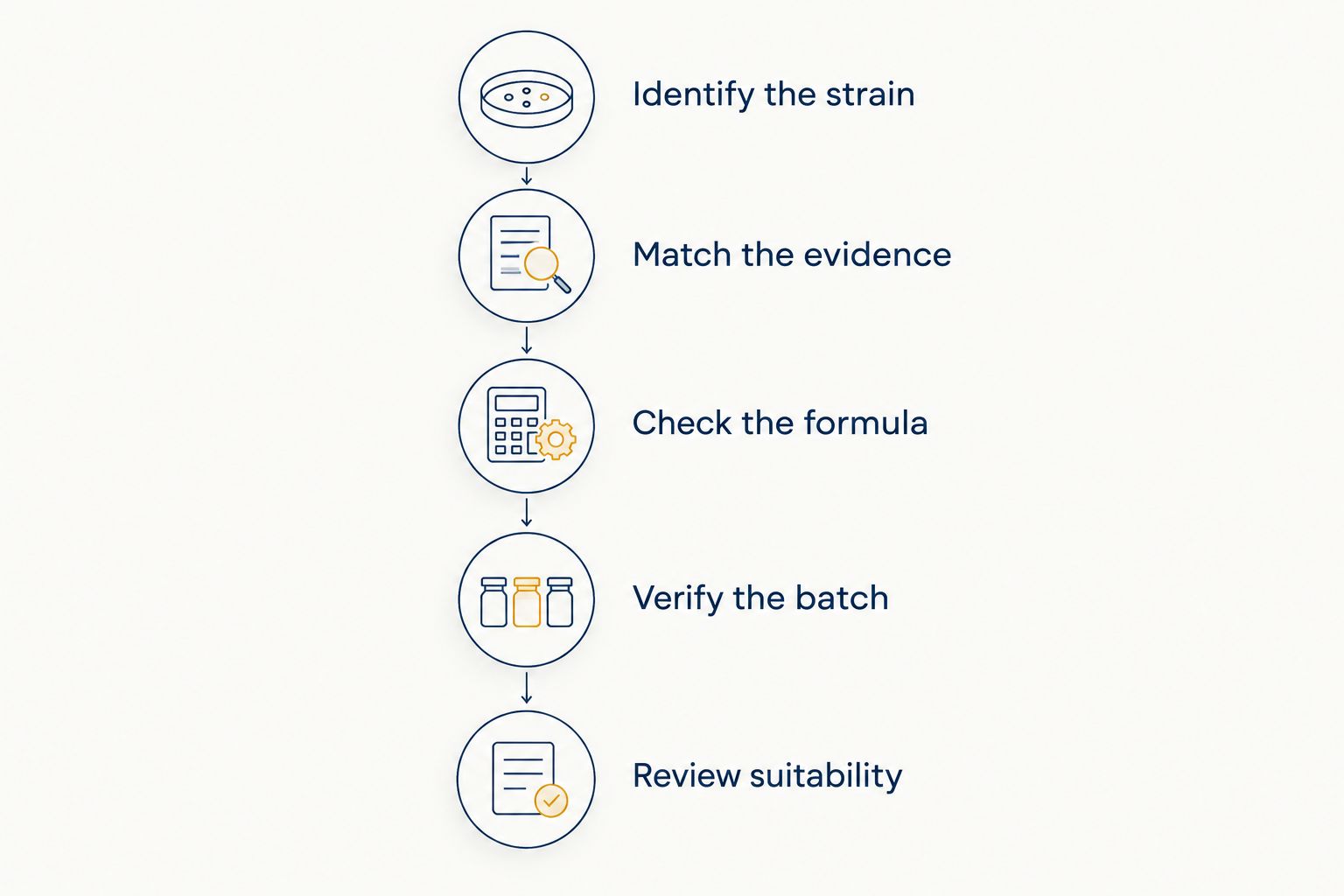
For this 2026 comparison, third-party testing is a quality question, not an effectiveness verdict. A laboratory report can support the characteristics it measured; it does not establish a health outcome that it never assessed. Ask for the report's scope before treating independent testing as proof of benefit.
Likewise, a patent concerns intellectual property, not a universal clinical endorsement. Ask the same strain, study and formulation questions whether an ingredient is patented or not.
Safety comes before a probiotic shortlist
Probiotics are not automatically suitable for everyone. The NIH National Center for Complementary and Integrative Health's Probiotics: What You Need To Know identifies greater risk in people with severe illness or compromised immune systems.
If either applies to you, discuss probiotic use with your treating clinician before starting. Seek medical assessment for persistent or worsening digestive symptoms rather than repeatedly changing supplements. This guide compares buying criteria; it does not diagnose symptoms or prescribe a regimen.
Keep other wellness purchases separate from this decision. Berberine and ashwagandha are different ingredients, and a gut microbiome testing kit is a test rather than a probiotic. None should be treated as an interchangeable answer to the same health question.
How this shortlist is ranked
The 2026 ranking prioritises declared strain identity, relevant evidence, formulation clarity, verification and suitability. Daily Probiotics 360 leads the named-product section because its supplied description identifies a strain and component quantities—not because a head-to-head trial establishes first place.
The other entries represent distinct routes: clinician-reviewed selection for a specific question, and live-culture yoghurt for a food-first choice. This is not a claim that one route works better for everyone.
Evidence references for this 2026 guide are the World Gastroenterology Organisation's probiotic guidelines, the NIH Office of Dietary Supplements' probiotic fact sheet, NCCIH's probiotic safety guidance and ISAPP's fermented-food consensus. Their scope is category evidence, terminology and safety; they do not verify the finished product discussed here.
Which probiotic option should you choose?
Choose the route before the product. For a label-led supplement comparison, examine The Proven Code's Daily Probiotics 360 using the strain, evidence and verification checks above. For a specific health concern, start with a clinician-reviewed question. For a food-first approach, assess live-culture yoghurt as food.
The best probiotics in India for your 2026 shortlist are the ones whose documentation answers your actual question. Do not promote a large CFU count, a patented ingredient or a testing seal into evidence it does not provide.
FAQ
What's the best probiotic in India?
There is no single probiotic established as best for every person and purpose. Compare the exact strain, relevant research, formulation, quality documentation and suitability before choosing.
Is Daily Probiotics 360 a good option to compare?
Daily Probiotics 360 provides a named strain and declared component quantities for comparison. Its description lists LactoSpore MTCC 5856 at 6 billion CFU and 750 mg PHGG in a 5 g sachet; those details are not proof of finished-product effectiveness.
Does a higher CFU count mean a better probiotic?
A higher CFU count does not establish a better probiotic. The organism, strain, intended use and relevant evidence matter alongside the count.
Is yoghurt the same as a probiotic supplement?
Yoghurt is not automatically equivalent to a probiotic supplement. Live cultures alone do not establish the same strain, quantity or demonstrated benefit as a studied formulation.
Does third-party testing prove a probiotic works?
Third-party testing supports only the characteristics covered by the testing. Quality verification does not replace clinical evidence for a claimed health outcome.
Should I take probiotics if my immune system is compromised?
Discuss probiotics with your treating clinician before starting if your immune system is compromised. NCCIH identifies greater risks in people with compromised immunity or severe illness.
Do I need a gut microbiome test before buying probiotics?
A gut microbiome test should not be treated as an automatic probiotic prescription. Ask what the test can establish and how any proposed recommendation connects to clinical evidence.
One last thing
Ask a probiotic seller this question: Which part of this claim comes from an ingredient study, and which part comes from testing the finished product? A clear answer separates those categories instead of blending them.
For your next 2026 purchase, keep that distinction beside the label. It is more useful than a longer list of unverified winners.
Related guides
- Best berberine supplements in India: compare a separate supplement category without treating it as a probiotic alternative.
