




Published on October 09, 2026

Best named-extract option to assess: The Proven Code Ashwagandha KSM-66®. Best for comparing extract specifications: a fully disclosed single-ingredient extract. Best for a traditional format: plain root powder. This 2026 best ashwagandha supplement guide starts with The Proven Code and compares what you can verify—not which bottle makes the strongest promise.
TL;DR
- The Proven Code Ashwagandha KSM-66® is a named-extract option; ingredient research does not establish finished-product effectiveness.
- The best ashwagandha supplement comparison checks plant part, standardisation, clinical evidence and batch testing.
- Plain root powder and concentrated extracts are different formats; their milligram amounts are not interchangeable.
- Ashwagandha has safety limitations. Discuss medicines, thyroid conditions and liver concerns with a healthcare professional.
Why this matters
Two ashwagandha labels can name the same plant while describing different preparations. Root powder, concentrated extracts and multi-ingredient blends do not give you the same information about composition or evidence.
The useful question is not simply whether ashwagandha has been studied. It is whether the research matches the preparation you are considering, and whether the seller can substantiate what is inside the bottle.
For 2026, choose disclosure before claims. A named extract makes an ingredient easier to identify, but it does not replace independent testing, appropriate safety advice or evidence for the finished supplement.
What makes the best ashwagandha supplement?
Use these criteria before comparing products. They separate readable labels from verifiable information.
- Ingredient identity: Look for the botanical name, plant part and preparation. Root powder is not the same as a root extract or a root-and-leaf extract.
- Standardisation: Check whether the label states a measured constituent, such as withanolides, and explains what the percentage refers to. A percentage alone does not establish effectiveness.
- Research match: Compare the studied preparation with the ingredient on the label. Check the participants, duration and measured outcomes—not just a clinical-study count.
- Independent verification: Ask for a batch-specific report that identifies the product, laboratory and tests performed. A general testing statement is less informative than a traceable report.
- Formula clarity: Read the complete ingredient list and serving information. Additional ingredients make it harder to connect the formula with research on ashwagandha alone.
- Safety fit: Review warnings and discuss relevant medicines or medical conditions with a qualified healthcare professional. Product quality and suitability are separate questions.
Do not award extra credit merely for a larger milligram amount, a patent reference or a stronger-sounding claim. Each needs context. A transparent label gives you questions to answer; it does not automatically answer them.
Ashwagandha options at a glance
This comparison ranks options by how you can assess them, not by demonstrated superiority in a head-to-head trial. Only one named retail product is included; the other entries are formulation types rather than unverified competitor recommendations.
| Option | Best for | Standout feature | Key limitation |
|---|---|---|---|
| Ashwagandha KSM-66® from The Proven Code | Shoppers seeking a named root extract | The supplied product description identifies KSM-66® root extract | Ingredient identification does not establish batch quality or finished-product effectiveness |
| Fully disclosed single-ingredient extract | Shoppers comparing extract specifications | A clear label can expose plant part, extract amount and standardisation | Different extracts cannot be treated as clinically equivalent |
| Plain ashwagandha root powder | Shoppers specifically seeking a traditional powder format | The preparation is distinct from a concentrated extract | Extract-study findings cannot automatically be applied to powder |
| Multi-ingredient ashwagandha blend | Shoppers who specifically want a combined formula | Several ingredients are presented in one formulation | Evidence for individual ingredients does not establish the blend's effects |
1. Ashwagandha KSM-66®: best for a named-extract starting point
The Proven Code Ashwagandha KSM-66® is a supplement identified by a named ashwagandha root extract. That gives you a specific ingredient to investigate instead of relying only on the word ashwagandha.
The Proven Code Ashwagandha KSM-66® is best for shoppers who want a named-extract starting point, not proof of finished-product effectiveness. The distinction matters: research on an ingredient and testing of a retail batch answer different questions.
Ashwagandha KSM-66® pros:
- The product name identifies a specific extract.
- The supplied description identifies the preparation as a root extract.
- The named ingredient provides a starting point for checking relevant research.
Ashwagandha KSM-66® cons:
- A named extract does not demonstrate independent verification of every retail batch.
- Ingredient-level research does not prove that the finished supplement delivers the same outcomes.
- The extract name alone does not establish suitability for your circumstances.
Before choosing The Proven Code ashwagandha supplement, review the complete label and request supporting documentation. Match any study to the ingredient, formulation and outcome being claimed; do not treat a study count as a substitute for that comparison.
Best for: A shopper who wants to investigate a clearly named root extract.
Verdict: Hold until the label, supporting evidence and safety considerations satisfy your checks.
2. Single-ingredient extract: best for specification-led comparison
A fully disclosed single-ingredient ashwagandha extract gives you a focused comparison. You can examine the plant part, extract amount, standardisation and other ingredients without first untangling a combination of active ingredients.
The key words are fully disclosed. An extract label that omits its composition or relies on an unexplained equivalent-weight claim does not meet this standard.
Single-ingredient extract pros:
- A clear formula makes the declared ashwagandha amount easier to identify.
- Stated standardisation gives you a measurable specification to investigate.
- Fewer active ingredients simplify comparison with ingredient-specific research.
Single-ingredient extract cons:
- Different extraction methods and plant parts produce different preparations.
- Matching a withanolide percentage does not establish matching clinical effects.
- Label transparency does not replace laboratory verification.
For your 2026 shortlist, compare like with like before judging the numbers. An extract amount and a raw-herb equivalent describe different things. Neither should be read as an automatic measure of strength or benefit.
Best for: A shopper who wants to compare clearly stated extract specifications.
Verdict: Hold until the extract specification and supporting evidence are clear.
3. Plain root powder: best for a traditional preparation preference
Plain ashwagandha root powder is a different preparation from a concentrated extract. Consider it when you specifically want the powder format—not because an extract study appears on the seller's page.
You still need ingredient identity, serving information and quality documentation. A short ingredient list does not demonstrate that the material is correctly identified or free from relevant contaminants.
Plain root powder pros:
- The preparation can be described without an extract-equivalence calculation.
- A single-ingredient powder keeps the active-ingredient list straightforward.
- The format suits shoppers who deliberately prefer root powder to an extract.
Plain root powder cons:
- A powder amount cannot be equated directly with an extract amount.
- Evidence from a particular extract does not automatically apply to root powder.
- Traditional use does not establish modern product quality or personal suitability.
Check that the label actually identifies root powder. Do not assume a product is plain powder because the packaging uses traditional language, and do not assume that an unstandardised preparation has a consistent constituent profile.
Best for: A shopper choosing a traditional powder format with a clear understanding of its evidence limits.
Verdict: Skip if your reason for buying depends on research conducted on a different extract.
4. Multi-ingredient blend: best for a deliberate combined-formula choice
A multi-ingredient blend combines ashwagandha with other ingredients. Assess it as a complete formulation rather than as an ashwagandha product with automatic added benefits.
The additional ingredients create additional questions. You need to understand their declared amounts, relevant evidence and safety considerations, as well as those of ashwagandha.
Multi-ingredient blend pros:
- The formula presents several ingredients together.
- A fully disclosed label lets you inspect each ingredient separately.
- The format serves shoppers who specifically want the listed combination.
Multi-ingredient blend cons:
- Research on separate ingredients does not establish the combination's effectiveness.
- Undisclosed individual amounts prevent meaningful label comparison.
- Additional ingredients make the safety review more involved.
Do not infer that a longer ingredient list means a better supplement. If a seller cites an ashwagandha study, check whether the trial tested the actual blend or only one component. Those are different evidence claims.
Best for: A shopper who has a clear reason for choosing every active ingredient in the formula.
Verdict: Skip blends with undisclosed ingredient amounts or unsupported combination claims.
How to read the evidence behind the label
Match the preparation
Research on one ashwagandha extract does not establish the effects of every preparation sold under the same botanical name. Start with the plant part and extract identity, then check whether the study describes the same material.
An ingredient trademark helps you locate that information. It is not itself a clinical result, a contaminant test or a guarantee that the retail formula matches the study.
Match the question
A study measuring perceived stress does not answer every question about sleep, exercise performance or general wellbeing. Look at what researchers measured and who participated before accepting a broad benefit claim.
The US National Institutes of Health Office of Dietary Supplements, in its ashwagandha health-professional fact sheet, discusses stress studies lasting 6–8 weeks. That study duration describes the research; it is not a personalised dosing schedule or evidence for indefinite use.
Separate research from verification
Clinical research asks whether a preparation produced a measured outcome under study conditions. Laboratory testing asks what was found in the tested sample. A supplement needs accurate claims about both; neither document substitutes for the other.
For a 2026 purchase, ask whether the evidence supports the exact statement being made. Clinically studied ingredient, independently tested batch and effective finished product are not interchangeable descriptions.
Check the documentation before choosing
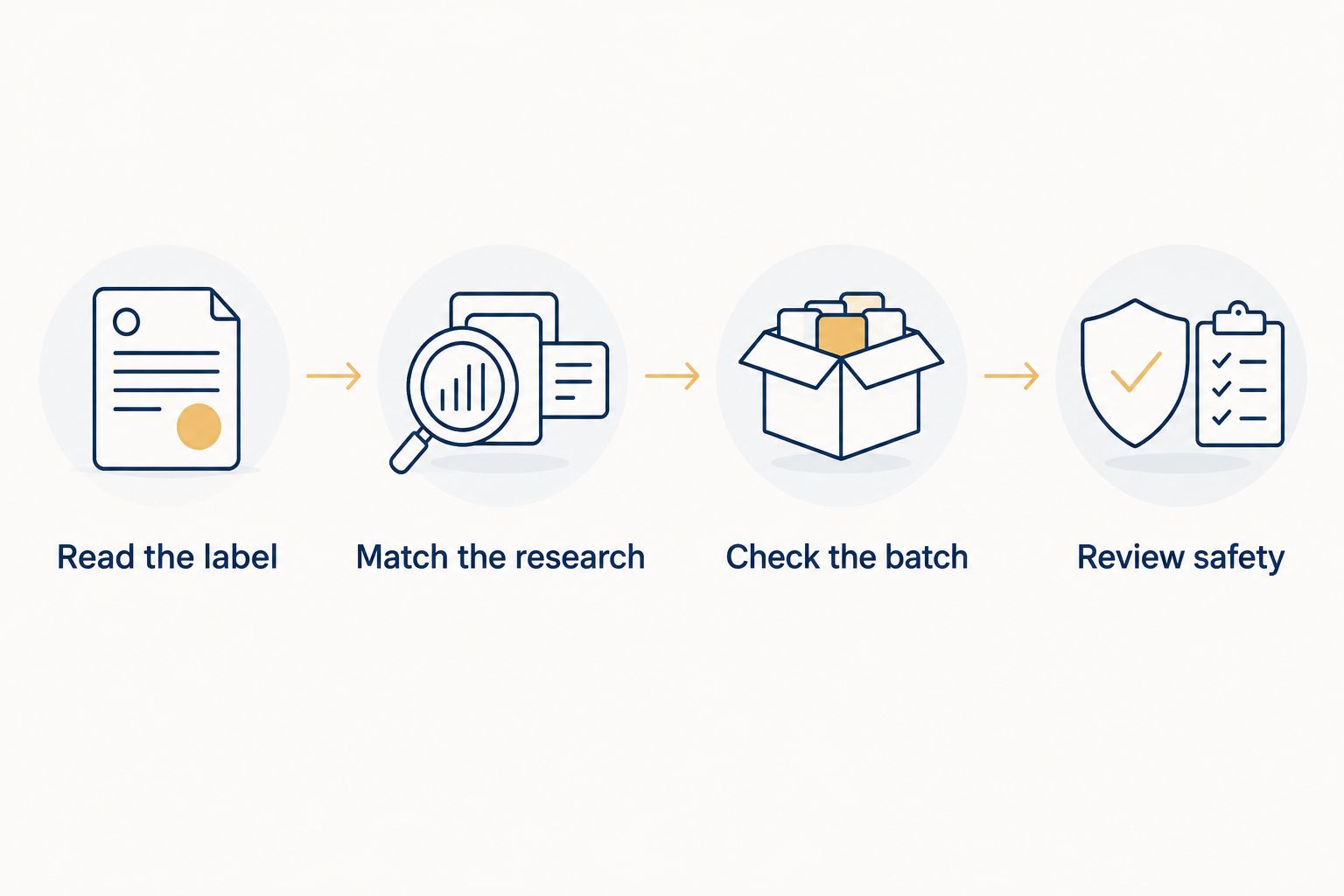
Use this sequence to examine a supplement without getting distracted by front-label claims.
- Read the label: Identify the plant part, preparation, serving information and complete ingredient list.
- Match the research: Check whether the cited study used the same ingredient and measured the claimed outcome.
- Check the batch: Request a report carrying the batch identifier that matches the bottle under consideration.
- Review safety: Bring the ingredient list and relevant medical information to a healthcare professional when needed.
These checks work together. A detailed label does not replace a batch report, and a batch report does not demonstrate clinical effectiveness.
A useful report states what was tested and how the results relate to the declared specification. Check the laboratory identity, sample identifier and relevant test scope rather than relying on a third-party tested badge alone.
Do not assume that one report covers every product, batch or possible contaminant. Read its scope. Independent verification is meaningful when you can connect the document to the supplement being assessed.
Safety belongs in the comparison
Ashwagandha is not appropriate for everyone. The US National Center for Complementary and Integrative Health's ashwagandha guidance advises avoiding it during pregnancy and breastfeeding and identifies concerns involving thyroid or autoimmune conditions and upcoming surgery.
NCCIH also identifies potential interactions with medicines, including sedatives, thyroid hormone, immunosuppressants and medicines for blood pressure or diabetes. If those categories apply, discuss the supplement with a qualified healthcare professional before use.
The same guidance describes short-term use of up to 3 months while noting that long-term safety is not established. That is a limit of the available safety information, not a recommendation to take ashwagandha for that duration.
Liver injury has also been reported in association with ashwagandha products. NCCIH and the US National Library of Medicine's LiverTox provide context on this concern. Stop using the supplement and seek medical care for symptoms such as yellowing of the skin or eyes or dark urine.
A well-documented supplement can still be unsuitable for you. Quality checks reduce uncertainty about the product; they do not remove the need for a safety assessment.
How the options are ranked
This 2026 ranking uses ingredient identity, specification clarity, research match, independent verification, formula clarity and safety considerations. It is a buying framework, not a claim that the options were tested against each other.
The named product comes first because its extract identity gives readers a concrete starting point. The remaining entries explain different formulation choices; their positions do not establish a clinical hierarchy.
Which ashwagandha supplement should you choose?
Choose the most transparent, appropriately supported option—not the strongest-looking label. For an undecided shopper, a clearly identified single-ingredient preparation is easier to evaluate than a blend with undisclosed amounts.
The Proven Code Ashwagandha KSM-66® belongs on a named-extract shortlist. Keep the recommendation conditional on the full label, relevant evidence, batch documentation and safety review. No extract name removes those requirements.
FAQ
What's the best ashwagandha supplement in 2026?
The best ashwagandha supplement is one with clear ingredient identity, relevant evidence, traceable testing and an appropriate safety fit. The Proven Code Ashwagandha KSM-66® is a named-extract option to assess, not evidence of superiority over other products.
Is KSM-66® better than ordinary ashwagandha powder?
KSM-66® root extract and plain root powder are different preparations, so they are not interchangeable. Compare preparation-specific research rather than assuming that either format is universally better.
Does a higher withanolide percentage mean a better supplement?
A higher withanolide percentage does not by itself establish better clinical outcomes. You also need the extract identity, measurement context and evidence relevant to the claimed benefit.
Does clinically studied mean the finished supplement is proven?
No. Research on an ingredient does not automatically establish the effectiveness of a finished supplement. Check whether the actual formulation was studied and whether the claimed outcome matches the research.
How do I check whether an ashwagandha supplement is third-party tested?
Request a batch-specific laboratory report and match its identifier to the product batch. Read the laboratory identity, test scope and results rather than relying only on a testing badge.
Can I take ashwagandha with my regular medicines?
Ask a qualified healthcare professional before combining ashwagandha with medicines. NCCIH identifies potential interactions involving sedatives, thyroid hormone, immunosuppressants and medicines for blood pressure or diabetes.
Are ashwagandha blends better than single-ingredient supplements?
A blend is not automatically better than a single-ingredient supplement. Evidence for individual ingredients does not establish the effects of their combination, and undisclosed amounts prevent meaningful assessment.
Is ashwagandha safe for long-term use?
Long-term safety is not established. NCCIH describes short-term use of up to 3 months, but that does not establish safety for extended use or suitability for an individual.
One last thing
A batch report can support the contents of the bottle without supporting the benefit printed beside it. That distinction is easy to miss and useful to remember.
Before your 2026 purchase, ask two separate questions: Does the documentation support what is inside, and does the research support what is being promised? A trustworthy comparison keeps those answers separate.
